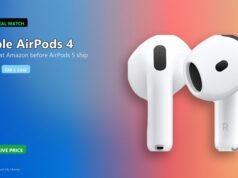





















AirPods 5 are Apple’s new entry-level earbuds, and the headline change is what the base model no longer leaves out. According to Apple’s press release, both AirPods 5 models include Active Noise Cancellation. The standard pair costs $129. A second model with a wireless charging case costs $149. Pre-orders opened on September 9 at Apple’s September event, and stores get stock on Friday, September 18.
That is a real price move. With AirPods 4, noise cancellation cost $179, and the $129 pair went without it. Consequently, the cheapest AirPods now do the job the $179 model used to.
What every AirPods 5 model gets

Apple says a new multiport acoustic architecture and improved computational audio remove up to 50 percent more external noise. The comparison is against AirPods 4 with ANC, and it comes from Apple’s own testing rather than a lab review. Transparency mode is also more natural. Adaptive Audio blends the two modes based on your surroundings, and Conversation Awareness drops the volume when you start talking.
Sound quality gets the same acoustic redesign, borrowed from AirPods Pro 3, plus next-generation Adaptive EQ. Apple claims richer detail across a wider range of ear shapes and a more immersive Personalized Spatial Audio. In addition, durability improves with better dust, sweat and water resistance.
The $149 model adds a wireless case and volume swipes
Spend the extra $20 and you get three things. First, a force sensor with volume swipe arrives on the stem, a first for Apple’s open-ear design. Second, battery life rises to five hours of ANC listening per charge, one hour more than AirPods 4 with ANC, thanks to a redesigned battery. The case stretches that to 22 hours. Third, the wireless charging case works with Apple Watch chargers, Qi chargers and USB-C.

Apple did not publish a battery figure for the $129 model in the release, which is worth noting before you pick the cheaper pair. Meanwhile, the standard model still charges over USB-C.
Siri AI, head gestures and Live Translation
The intelligence features depend on your phone, not the earbuds. With an Apple Intelligence iPhone, AirPods 5 give hands-free access to Siri AI, which launches in beta with iOS 27 on September 14 in English only. You can also answer Siri by nodding or shaking your head. Apple’s examples include playing a song a friend recommended in a message, or navigating to a dinner reservation buried in an email. Live Translation now works across the entire AirPods lineup. You set it up in the Translate app and download the languages you need. Then you press both stems, ask Siri, or use the iPhone Action button to hear a conversation in your own language. However, the expressive Siri voices and upgraded Dictation need a newer phone. Apple’s footnotes list the iPhone 17 Pro, iPhone Air and later models. We covered the Siri AI limits in iOS 27 separately.
Dave Pakula, Apple’s vice president of Hardware Engineering, framed the launch around access. “Both AirPods 5 models deliver a world-class listening experience and enable features like Live Translation for even more people,” he said.
The fine print
Apple’s “best-in-class” ANC claim rests on its own July tests against the bestselling open-ear headphones at the time. Those tests used prerelease firmware and an iPhone 17. Personalized Spatial Audio still needs an iPhone with a TrueDepth camera to build your profile. Full functionality also requires the latest operating system on the paired device. Pre-orders are open in the U.S. and more than 65 other countries, and both models reach stores on September 18.
On materials, Apple says AirPods 5 use 40 percent recycled content overall. That includes 70 percent recycled plastic in the wireless case and 100 percent recycled cobalt in the battery. The packaging is fiber-based. Those figures follow Apple’s usual mass-balance accounting, so they describe the average product rather than every unit.
What Apple did not announce
AirPods 5 were the only earbuds at the event. The camera-equipped AirPods that surfaced in a macOS 26.7 clip in August stayed unannounced. Engadget, citing Bloomberg, now expects them next year. For now, the choice is simpler than it was: $129 buys noise cancellation, and $149 buys the case and the swipe.